Literal Lean
Literal Lean #2: Treat the Symptom or the Disease?
Literal Lean: Designing Products and Facilities for Environmental Success
In my last post I introduced literal lean: the elimination or repurposing of physical waste. We looked at hazardous waste and how to return valuable single-use polymers to the economy.
Some of you will have thought: good, but you are treating the symptom, not the disease.
You are right. So this post looks upstream, at the product lifecycle.
What is Extended Producer Responsibility (EPR) in manufacturing?
Extended Producer Responsibility (EPR) will reshape how we design products. In 2024, the EU reached a regulatory milestone requiring Member States to have EPR schemes covering all packaging, with those schemes intended to encourage packaging designed for reuse or high-quality recycling Regulation moves slowly. The waste keeps arriving. Until products are designed for repurpose, treating the symptom is the best option we have.
Design for environment belongs in every manufacturer’s design process. I would go one step further. Design for environment should cover the facility as well as the product.
Why the facility? Repurposing fails on two things: the range of materials in a waste stream and the market value of each. A low-value polymer stream is often not worth a recycler’s time. Mixed with other streams, it loses its value altogether.
The answer sounds simple: segregate. From experience, it is far easier said than done. Most of us sort our waste at home without thinking. We leave the habit at the door when we go to work.
Take the blood tube in the graphic below.
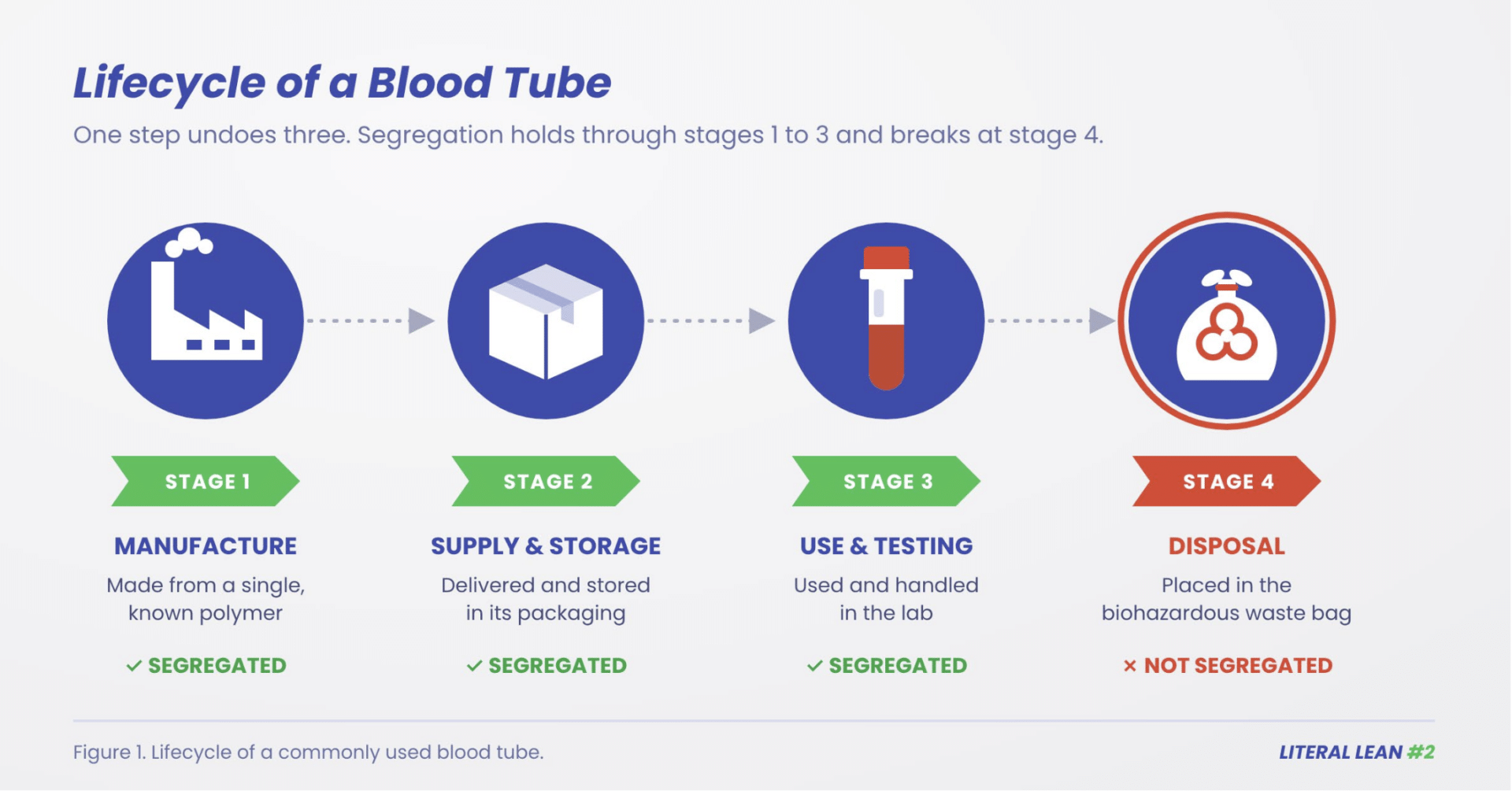
- Stages 1, 2 and 3: the material stays segregated.
- Stage 4: we place the tube in the biohazardous waste bag.
One step undoes three. The segregation path breaks and the recycling path gains complexity.
This one step adds three lean wastes.
- Over-processing: someone downstream sorts what we mixed, or nobody does and the material goes to landfill or incineration.
- Transport: mixed waste travels further to reach a facility licensed to handle it.
- Defects: a contaminated stream is a rejected stream.
The cause sits in the facility design. When the right bin is not at the point of use, or the rules send everything to one bag, people use the bin in front of them. Lean has a tool for designing the mistake out: poka-yoke. We will come back to it later in the series.
So design for environment needs two questions:
- Product: is this material designed to be repurposed?
- Facility: is the building designed so it gets repurposed?
Over to you
In your organisation, does design for environment stop at the product, or does it reach the facility floor?
Next in the series: Literal Lean #3, The case for a ninth waste.
Key Takeaways
Extended Producer Responsibility (EPR) is shifting the burden of product lifecycles back to manufacturers, driving a push toward highly recyclable product designs. However, sustainable product design is rendered useless if the facilities where these products are used are not equipped to handle proper waste segregation at the point of use.
When facility design fails to provide accessible segregation options, clean materials are mixed with hazardous ones, creating unnecessary lean wastes such as over-processing, excessive transport, and material defects. To achieve true environmental success, organisations must ensure that both their products and their physical workspaces are actively designed to support material repurposing.