Literal Lean
Literal Lean #3: The case for a ninth waste
Why Physical Material Should Be the Ninth Waste of Lean
Lean has added a waste before. It is time to add another.
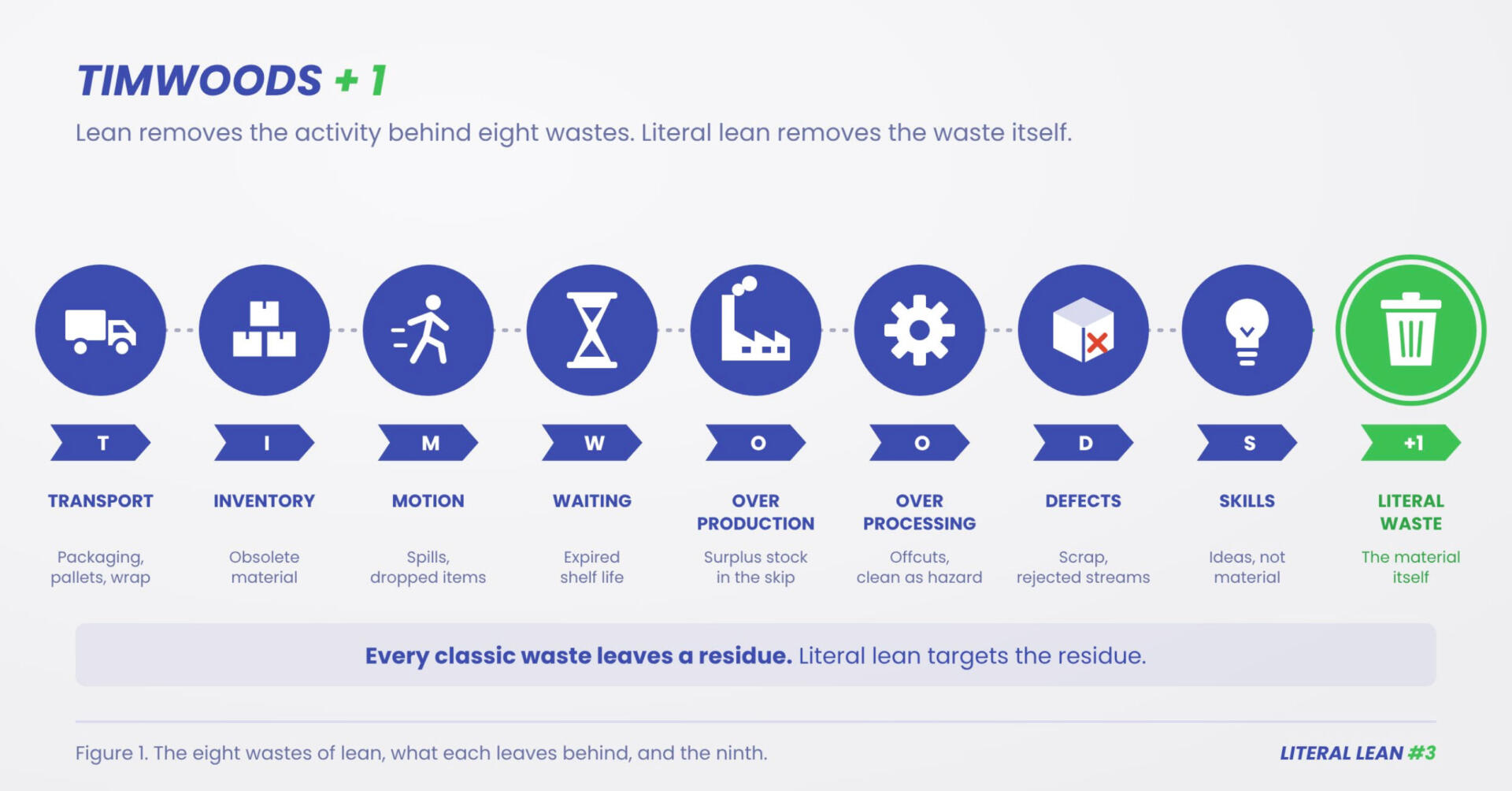
Taiichi Ohno gave us seven wastes. In The Toyota Way (2004), Jeffrey Liker added an eighth: unused employee creativity. Most of us now teach the list as TIMWOODS:
- Transport
- Inventory
- Motion
- Waiting
- Overproduction
- Over-processing
- Defects
- Skills
The eighth waste met little resistance. Once someone named it, everyone saw it.
I believe the ninth is as obvious. The physical waste itself. The plastic, the packaging and the scrap leaving your building in a skip or a biohazard bin.
Test it against lean’s own definition
Lean defines waste as anything adding cost without adding value for the customer. Apply the test to the material in your bins.
- You pay for it when you buy it.
- You pay to store, handle and move it.
- You pay again to dispose of it.
Three costs. Zero value to the customer. By the definition every lean practitioner learns on day one, physical waste qualifies.
Every classic waste leaves a residue
Walk through TIMWOODS and ask what each waste leaves behind.
- Overproduction leaves expired stock in a skip.
- Inventory leaves obsolete material.
- Defects leave scrap.
- Over-processing leaves offcuts and extra consumables.
- Transport leaves pallets, wrap and packaging.
We measure the classic wastes in minutes and euros, never in kilograms. The residue drops off the value stream map at the loading dock.
The bag the seven wastes never see
Take one single-use bioreactor bag through TIMWOODS.
- Inventory: bags held in stock against the batch schedule, some past their expiry.
- Transport: packaging in, waste hauled out to an incinerator.
- Over-processing: clean plastic treated as biohazard. ISPE’s 2024 study found 53% of single-use bioprocess plastic is non-contaminated, against 14% contaminated.
- Defects: a mixed stream no recycler will accept.
The classic wastes all show up. Now fix all four. The bag still ends in the fire.
The seven wastes find the waste around the bag. They never see the bag. This is the gap literal lean fills.
Has this been said before?
Partly, and credit where it is due. The US EPA’s Lean and Environment Toolkit already suggests an eighth waste: environmental waste. It defines it as an unnecessary use of resources, or a substance released to air, water or land, which could harm human health or the environment.
Literal lean differs in one way. The EPA lens asks how much harm the waste does. Literal lean asks how much value the waste still holds. One treats waste as a liability to reduce. The other treats it as feedstock to recover.
Is physical waste a ninth waste or the sum of the other eight?
There are two ways to see it:
1. Physical waste is a ninth waste, with its own root causes, owners and metrics.
2. Physical waste is the evidence of the other eight, the trail they leave.
My view: it is both. And because nobody owns it, nobody improves it. Facilities pays the disposal invoice. Operations never sees it. Design never hears about it. Procurement buys the same material again next month.
So here is a working definition. Literal waste is any material entering your process, adding no value to what the customer receives, and leaving your site.
Three questions find it:
1. Did we pay for it?
2. Did the customer receive it?
3. Where did it go?
Lean removes the activity creating waste. Literal lean removes, or repurposes, the waste itself.
Over to you.
Is physical waste a ninth waste, or the sum of the other eight? And if it is a ninth, what letter does it add to TIMWOODS?
Next in the series: Literal Lean #4, Weigh it.
Sources: ISPE Pharmaceutical Engineering, Nov/Dec 2024, US EPA Lean and Environment Toolkit, Chapter 2
Key Takeaways
Traditional Lean methodology measures inefficiency in time and money across eight classic wastes (TIMWOODS), allowing physical materials such as packaging, scrap, and single-use plastics to fall off the value stream map at the loading dock. Because discarded materials incur purchasing, handling, and disposal costs while delivering zero customer value, physical waste meets Lean’s core definition of waste and leaves behind a costly trail that no single department currently owns.
Literal Lean bridges this gap by shifting the focus from simply reducing environmental harm to recovering the material value still locked inside discarded streams, such as the 53% of single-use bioprocess plastics that remain uncontaminated. By asking whether a material was paid for, whether the customer received it, and where it ended up, organisations can connect procurement, operations, and facilities to eliminate or repurpose physical waste at its source.
Previous article